
When we think about a UPS, we usually focus on the device itself. We check its power rating, backup time, number of sockets, or operating mode. In practice, however, it is the battery that determines whether everything will work as expected during a power failure. Even the best UPS may fail to do its job if the battery is worn out, poorly matched, or neglected. It is a bit like with a car: you may have an excellent engine, but if the battery refuses to cooperate, you will not get far.
For many users, the topic only comes up when the first serious power outage occurs. Suddenly, it turns out that the device does switch to emergency mode, but the actual backup time is much shorter than expected. That is why it is worth knowing what everyday battery maintenance looks like, what affects battery life, and how to check whether everything is working properly. The good news is that taking care of UPS batteries does not have to be complicated. The most important things are regularity and avoiding a few common mistakes.
Why the condition of a UPS battery matters so much
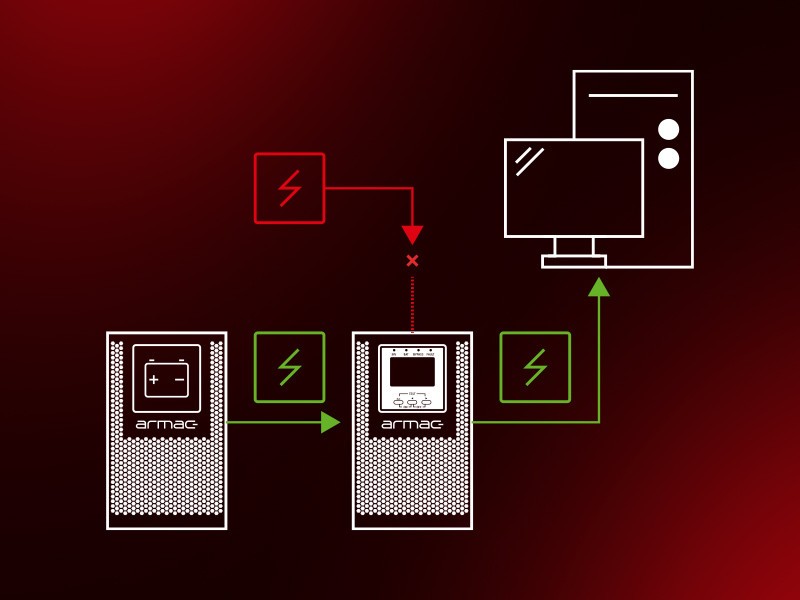
Under normal conditions, the device uses mains power, while the battery remains on standby. However, when there is a power interruption, the UPS switches to battery mode and powers the connected equipment for a certain period of time. This is when the discharge time reveals the real condition of the battery, not just the information on the label or in the catalogue.
A properly functioning UPS battery allows you to save your work, safely shut down systems, or simply wait out a power outage. At home, this means protecting a computer, router, or monitoring system. In a company, it often involves servers, network devices, and important workstations. In more demanding applications, such as data centers, industrial environments, or extensive emergency power systems, a reliable battery becomes a truly critical component. In such cases, it is no longer just about convenience, but about business continuity, data security, and reducing downtime costs.
What has the greatest impact on battery life
The biggest enemy is operating temperature. Excessive heat causes the battery to age faster, lose capacity, and tolerate subsequent cycles less effectively. In practice, overheating is very often what shortens battery life, even if the UPS itself appears to be working correctly most of the time. A device placed in a tight cabinet, near a radiator, or in an area with poor airflow will operate in worse conditions than equipment located in a well-ventilated room with adequate cooling.
The second important issue is the way the battery is used. Many people believe that it is good to heavily discharge a battery from time to time because it will “work better” that way. However, this is not the best practice. Deep discharging does not improve the condition of the battery and may actually make it worse. A battery also does not tolerate being left in a discharged state for a long time.

What batteries are most commonly used in UPS systems
Most small and medium-sized UPS units use VRLA batteries, often in a 12 V version. This solution is popular because it is convenient to use, relatively durable, and works well in typical office and home applications. In larger installations, more advanced technology may be used, but the principle remains similar: the battery must be ready to deliver energy quickly whenever the power supply fails.
When choosing or replacing a battery, it is not enough to check only whether the size matches. Rated voltage, battery capacity expressed in Ah, and operating characteristics under load are also important. For a UPS user, the key point is that the new battery should have the correct voltage and capacity and should be designed for use in emergency power systems. A UPS is a device with a specific operating profile: most of the time it remains on standby, but at the critical moment it must deliver energy quickly and steadily.
Does a UPS battery need to be discharged regularly?
This question comes up very often because there are many myths surrounding it. In practice, modern UPS batteries should not be intentionally deeply discharged without a clear service or testing purpose. Controlled testing does make sense, but there is a difference between a planned test supervised by the device and bringing the battery to an extreme discharge level “for its health.” Such a practice may actually accelerate cell wear.
After a power disturbance, the UPS should have time to recharge. The owner of the device should also avoid situations in which the battery remains discharged for a long time or is constantly overloaded. Deep discharge below a safe level, meaning discharge to a voltage that is too low for a given model, may lead to a permanent decline in parameters and is not recommended. In practice, this means lower performance, shorter backup time, and a greater risk that the system will not work as expected during the next outage.
Practical guide: how to care for a battery pack and UPS batteries
Taking care of a UPS battery is not about one major action, but rather a set of sensible habits. First of all, it is worth ensuring good operating conditions for the device. The location should be dry, clean, and as cool as possible, without the risk of overheating. In everyday use, it is also very important not to block ventilation openings and not to place the UPS where hot air has no way to escape. A small detail? Only seemingly. These are exactly the kinds of details that often make the difference between a battery that works properly for several years and one that needs to be replaced much sooner.
The second issue is a sensible approach to load. After buying a UPS, many people gradually connect more and more devices to it until, at some point, the system is operating almost at the limit of its capabilities. The safety margin quickly disappears, and the required backup time no longer reflects reality. If reliable operation is important, it must be remembered that the battery capacity and runtime declared by the manufacturer depend on what is actually being powered during an outage.
Caution is also needed during servicing and replacement. Very old and new batteries should not be mixed in one set, because the entire pack will perform only as well as its weakest element. Over time, differences in charging, uneven operation, and problems maintaining parameters may appear. As a result, the theoretical rated capacity does not translate into real-world performance. This is why, in larger battery pack modules, the consistency of the entire set is so important.
How to check whether a UPS battery is still functional
This is one of those topics that users often postpone because, as long as everything works, there seems to be no need for inspection. The problem is that battery wear is not always immediately noticeable. Sometimes the UPS behaves normally and does not display any serious alarms, yet the actual backup time is already much shorter than it used to be. That is why it is worth checking the battery condition from time to time instead of waiting for the first unpleasant surprise.
The most reliable method is a test under real or controlled load. Such a detailed test shows whether the UPS is actually able to power devices for the expected amount of time. Voltage measurement alone can be helpful, but it does not provide the full picture. A battery may have a correct open-circuit voltage and still fail under load. More advanced diagnostics also take internal resistance into account, and an increase in this value usually indicates progressive cell aging and a reduced ability to deliver energy. This is why battery internal resistance is one of the parameters that service technicians take very seriously.
Simple observations should not be ignored either. If the battery heats up more than before, the casing looks suspicious, deformation appears, or the device increasingly signals a problem, it is a sign that a more detailed inspection is needed. In extreme cases, a damaged battery may mean leakage, an electrolyte problem, or even a situation that can pose an explosion hazard. These symptoms are not something worth “watching for a little longer.” A quick response matters here.
When it is time to replace battery packs
There is no single date after which every battery automatically needs to be replaced, but there are clear signs that its best period is already behind it. Most often, the owner notices this simply through reduced runtime. A UPS that shortly after purchase could easily support devices for several minutes suddenly works only briefly. It may also happen that the system charges the battery for a long time, yet the result is still poor. This is usually a sign that the battery’s real capacity is already significantly lower than the capacity declared by the manufacturer.
In such a situation, battery replacement should not be postponed. The more critical the application, the less sense there is in taking risks. In home use, this may mean losing work or restarting equipment. In a company, it can mean a real risk of downtime or infrastructure problems. In environments such as server rooms or data centers, delaying battery replacement is simply not cost-effective. The cost of a new set is usually much lower than the cost of the consequences of failed operation during a power outage.
Practical selection of a new UPS battery
Choosing a new battery should not be based on the rule “as long as it fits.” Parameter compatibility and intended use must be considered. What matters is not only the rated voltage, but also the total battery capacity, operating characteristics, and compatibility with the specific UPS model. Sometimes users assume that a higher capacity will automatically solve all problems. This is not always the case, because the charging method, installation space, and whether the UPS was designed to work with a particular battery type also matter.
Particular care should be taken with replacements. A battery with similar voltage may differ in behavior under load, permissible discharge current, and durability in standby operation. In practice, it is best to follow the manufacturer’s specification and consider the actual application. If the system is meant to support critical devices, it is not worth saving on quality. A properly selected battery translates not only into better backup time, but also into greater reliability of the entire system.
Good battery maintenance means fewer failures and greater peace of mind for users
In everyday UPS operation, it is easy to forget that the battery is a consumable component. Only during the first serious outage does it become clear whether the system was truly ready. That is why UPS battery maintenance should not be treated as something unnecessary or reserved only for service technicians. Even simple, regular supervision of operating conditions, charging time, and device behavior can significantly extend battery life.
This is the whole point of taking care of a UPS. It is not just about the battery itself, but about the certainty that when the power goes out, everything will work without stress. In practice, this means fewer surprises, a lower risk of failure, better equipment protection, and greater comfort. Whether the UPS stands under a desk, operates in a company server room, supports emergency lighting, or forms part of a more extensive emergency power system, one thing remains unchanged: it is worth taking care of the battery before it starts causing problems.

Summary
Good battery condition is the foundation of effective UPS operation. It is the battery that determines whether the device will actually keep equipment running during a power outage or merely signal a problem and shut down after a moment. If you want to extend battery life, ensure the right temperature, do not overload the device, avoid unnecessary deep discharge, and check the actual condition of the battery from time to time.